 EN
EN  DE
DE 

Insights into species conservation: habitats for the sand lizard (Lacerta agilis)
The sand lizard (Lacerta agilis) prefers to live in semi-open, dry and mosaic-like habitats.
This applies to many areas characterised by human activity. Examples include embankments, railway lines, extensively used meadows and fallow land.
This is why the sand lizard, which is strictly protected by the Federal Nature Conservation Act (BNatSchG), often has to be taken into account in construction projects.
In order to protect the local populations on the sites of construction projects, it is necessary in some cases to relocate them to specially created replacement habitats before construction begins.
Planning replacement habitats - „The messier, the better“
One rule applies above all to the replacement habitats: The messier, the better.
In addition, care should be taken during planning to ensure that they are of the same or even better quality than their old habitat.
In order to create the necessary mosaic of structures for hiding, basking, hunting, breeding and hibernating, sunny areas are initially required in which, at best, species-rich vegetation areas of grasses, herbs and perennials as well as open ground areas are already present.
If this is not the case, they should be created. Further structures are still missing for a suitable sand lizard habitat. These are made of Dead wood, stones and sandy soil produced in various constellations.
Care and relocation of the animals
Replacement habitats often require follow-up maintenance after completion in order to maintain the diversity of the various structures.
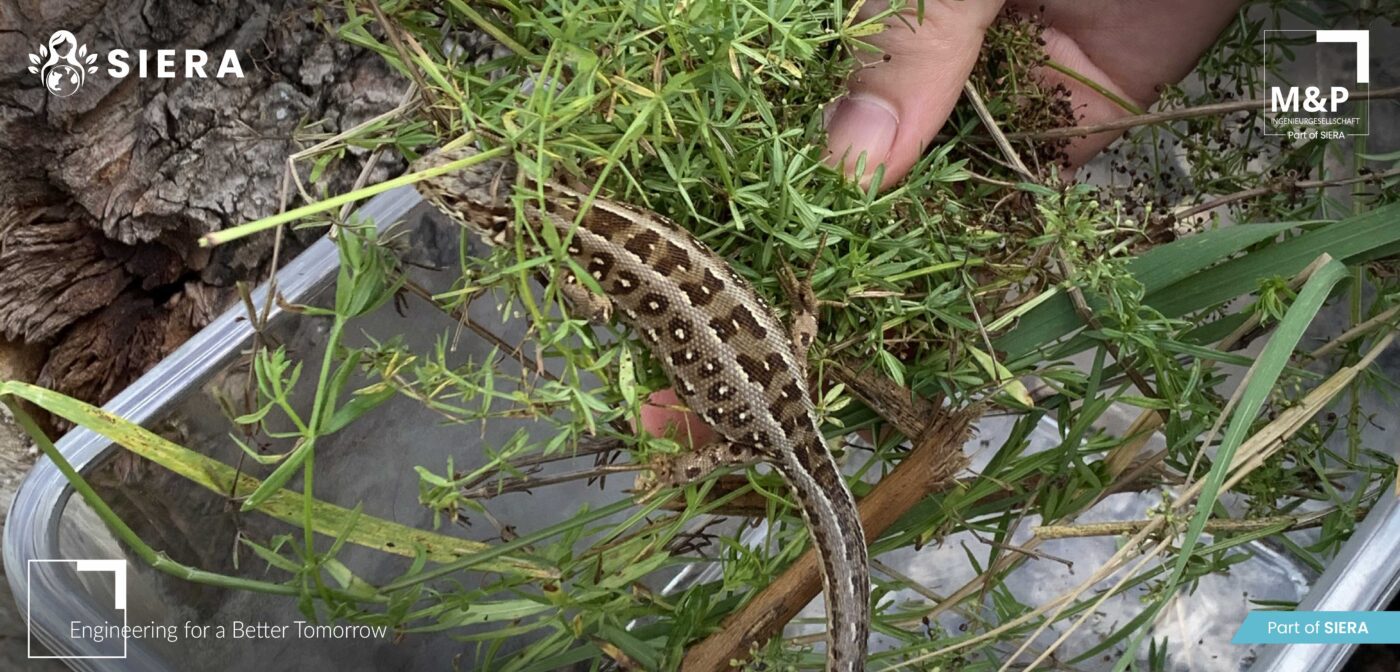
Once the replacement habitats have been completed, the trapping of sand lizards can begin.
The catch is made with the utmost care by hand, with the help of snares, a sponge or a landing net.
Trapping is prohibited under the BNatSchG and may only be carried out with the authorisation of the competent lower nature conservation authority.
The animals are then transported to their new habitat in a suitable transport container and released.
Sustainable protection through expertise
If you would like advice or support regarding sand lizards for your projects or have any questions about species protection or nature conservation law, the M&P Ingenieurgesellschaft mbH - member of the SIERA Alliance - in Hanover gladly at your side.
🌿 Get in touch now!
Let our experts advise you - we support you in your projects relating to species protection, environmental planning and ecological construction monitoring.
👉 Find out more on the website of M&P Ingenieurgesellschaft