 EN
EN  DE
DE 
Invisible danger underground
Decades after the end of the Second World War, an invisible threat still lies dormant at the bottom of many German waters: sunken bombs, grenades and ammunition remnants. These contaminated sites are often hidden beneath the sediments of the last 80 years - a latent danger for people, the environment and planned remediation measures. The safe recovery of these munitions is a technically complex and interdisciplinary task - and a mandatory prerequisite for any sustainable water remediation.
A project with depth: Explosive ordnance clearance as a first step
A current project of the M&P Ingenieurgesellschaft - Member of the SIERA Alliance in Hanover exemplifies the challenges.
The contaminated sediment was to be removed from a rainwater retention basin in need of remediation. However, before the suction excavator could move in to remove the sediment, a thorough investigation of the water bed was required - the basin had already existed before the Second World War.
With the help of state-of-the-art water sounding, a specialised company examined the water bed from the surface using a high-resolution 5-channel system. The aim was to identify suspicious structures in and under the sediment.
The evaluation quickly confirmed that remediation was not possible without prior explosive ordnance clearance. In close co-operation between the internal specialist departments Explosive ordnance, nature conservation and water remediation M&P developed a comprehensive clearance concept including tender documents and an accompanying landscape conservation plan in accordance with the specifications of the lower nature conservation authority.
From suspicion to controlled demolition
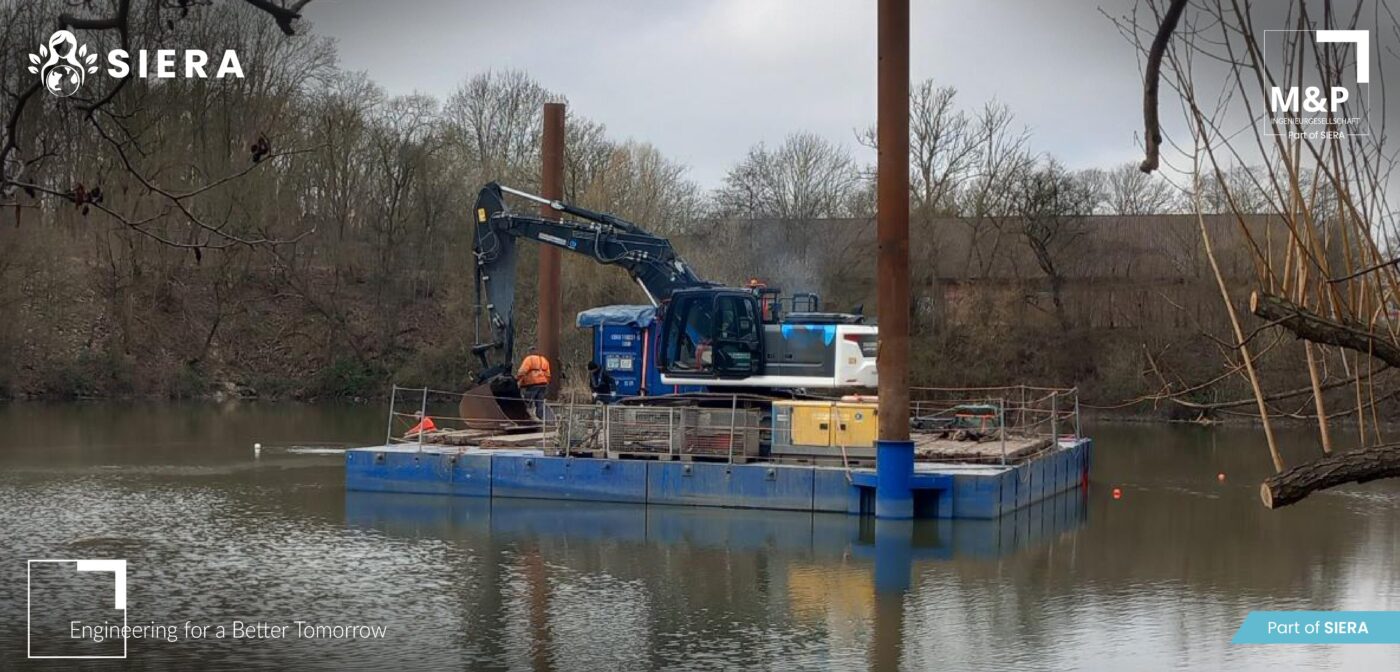
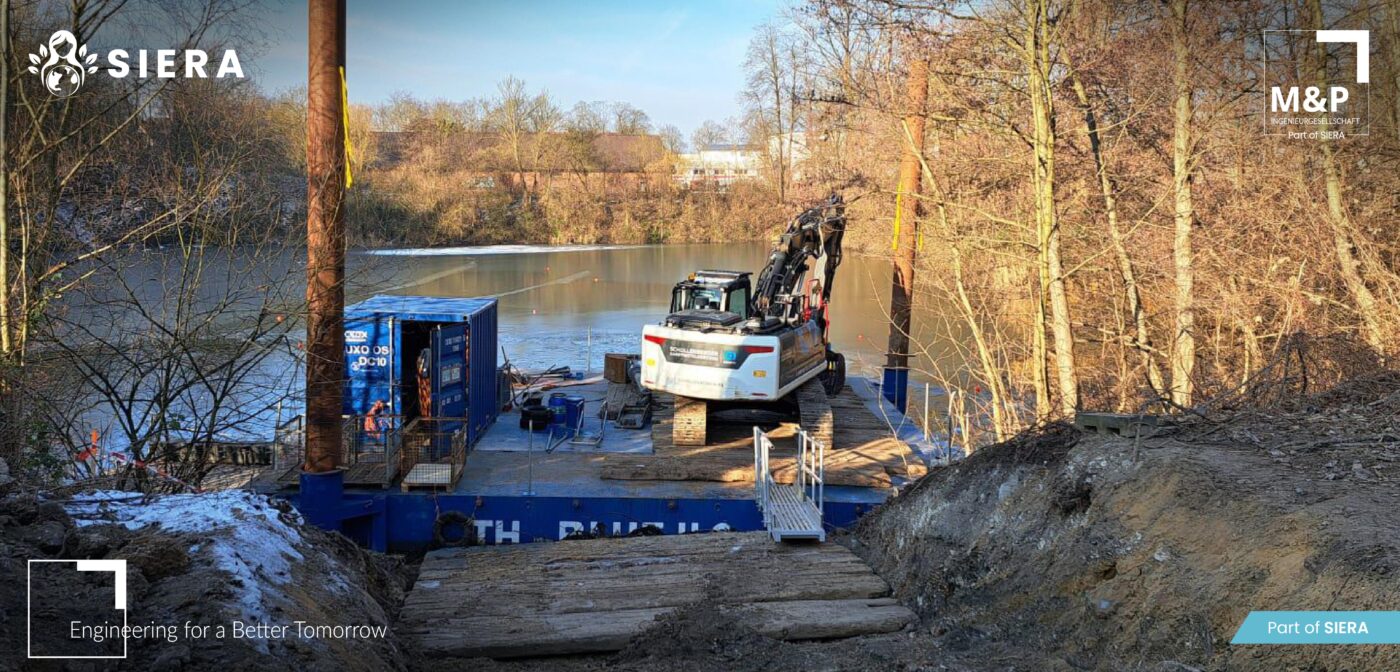
The clearance began with a salvage complex consisting of a 15 × 15 m pontoon with a hydraulic excavator and two groups of divers. In addition to small metal objects, larger, deeper-lying suspected objects were also discovered during the preliminary sounding.
The inspection by divers confirmed the worst suspicions: it was a Five-centner bomb with intact long-term detonator.
The explosive ordnance disposal service and the fire brigade, as the hazard prevention authority, responded immediately - a restricted area was set up, emergency services were coordinated and, after the residents had been successfully evacuated, a controlled demolition was carried out on site.
A widespread problem - and a central task
Such finds are not isolated cases, but reflect a widespread problem of urban waters. Explosive ordnance clearance is far more than a safety-relevant intermediate stepOnly when the explosive past has been eliminated can the future of the watercourse begin - through the removal of polluted sediments, the restoration of ecological and water management functions and the reclamation of valuable natural areas.
Conclusion: Security creates the future
The experience from Hanover shows how essential interdisciplinary planning and technical precision are for the safe remediation of polluted water bodies.
With projects like this M&P Ingenieurgesellschaft - Member of the SIERA Alliance make an important contribution to a sustainable and safe approach to our environment.