 EN
EN  DE
DE 
Investigation of a suspected old landfill site from historical research and orientating investigation to basic waste characterisation and risk assessment - using the example of a site in Leer
The M&P Ingenieurgesellschaft Hannover - Member of the SIERA Alliance was commissioned with the detailed investigation of a site in Leer as part of a planned construction project. The aim was to clarify whether known old deposits from the surrounding area protrude into the area and whether previous or current uses could potentially have led to soil or groundwater contamination.
This article provides an insight into the structured approach of the M&P Engineering Company Hanover - from historical research and orientational investigation to basic waste characterisation and initial risk assessment.
1. historical research: the basis for any reliable assessment
At the beginning, historical documents were systematically compiled and analysed. These included in particular
- historical maps
- Aerial photographs from different eras
- Multi-temporal analyses of land use
The analysis showed that it was not possible to completely exclude possible extensions of a neighbouring old landfill to the south. This resulted in an immediate need for investigation, which the M&P Engineering Company Hanover subsequently deepened in the field.
2. exploratory investigation: small pile-drilling, excavator trenching and groundwater sampling
Based on the results of the research, a targeted exploration of the underground was carried out. This involved
- Small pile-drilling (KRB) sunk
- Excavator trenches created
- Ramming level installed for groundwater sampling in the upstream and downstream of the current operation
Results of the floor speech
- Eastern study area: largely unremarkable soil conditions
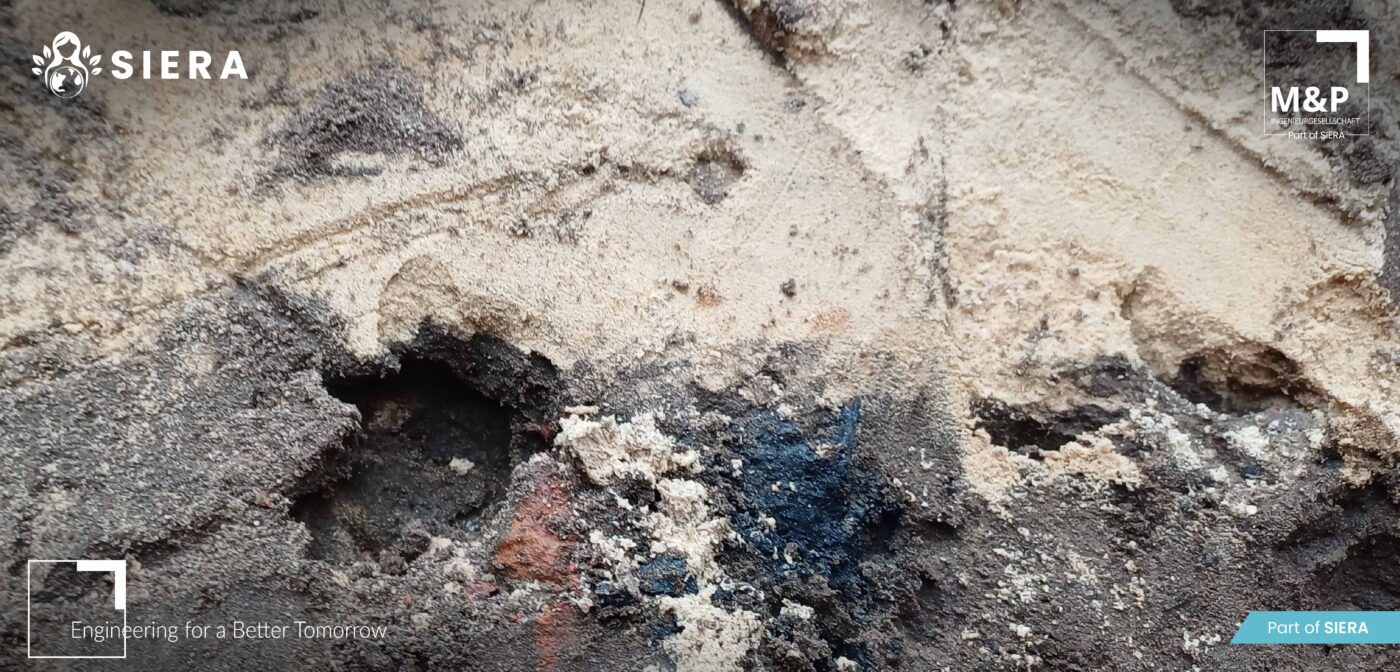
- Western site area: In the southern section there were clear Landfill residues to light
- up to 50 % Minority interests
- Materials: metal, building rubble, glass, ceramics
- Clear assignment to the known southern old landfill
These findings confirmed the suspicion that parts of the historical deposits extend into the site.
3. waste analysis and analysis in accordance with the Substitute Building Materials Ordinance
As the planned construction project Soil as a displacement material the samples taken were analysed extensively. The M&P Engineering Company Hanover carried out investigations in accordance with:
- Substitute Building Materials Ordinance (EBV)
- Federal Soil Protection and Contaminated Sites Ordinance (BBodSchV)
- Soil-human impact pathway
- Soil-groundwater impact pathway
Analytical results
The consistency of the pollutant patterns was remarkable:
- Similar pollutant profile in:
- of the deposit sample
- of the immediately neighbouring groundwater sample
This suggests that the landfill residues may have produced a Pollutants entering the groundwater takes place.
At the same time, the sands below the deposits No abnormalities.
4 Initial risk assessment: What can already be said?
The following facts were clearly delineated in the course of the orientating investigation:
What could be excluded
- Contamination of soil or groundwater by the Current environmentally relevant use of the location is not before.
What remains unclear
- Whether the observed groundwater contamination clear to the landfill residues could still be determined. not conclusively clarified.
This means that further investigations are required, in particular to determine the exact origin of the pollutants.
5. necessity of a detailed examination (DU)
In order to be able to conclusively assess whether a hazard exists in accordance with the BBodSchV, a Detailed examination (DU) required. This should:
- the Origin of the contamination clearly determine
- the Soil-groundwater impact pathway analyse in depth
- a resilient Hazard assessment at the place of assessment enable
- Creating a data basis for possible measures or reorganisation concepts
The M&P Ingenieurgesellschaft Hannover - Member of the SIERA Alliance will once again apply a structured, standardised procedure in order to create clarity for the client and the planned construction project.
6. table: Overview of the investigation modules
| Examination module | Objective | Result / realisation |
| Historical research | Examination of utilisation history & old deposits | Suspicion of offshoots of the southern deposit remains |
| Small pile driving & excavator trenching | Testing the soil conditions | Landfill residues in the west up to 50 % Foreign matter |
| Groundwater samples | Assessment of the soil-groundwater impact pathway | Similar pollutant pattern as landfill sample |
| Waste analysis according to EBV | Valuation BV-external realisation | Site shows contamination in backfill material |
| Basic risk assessment | Clarification of potential risks | Cause of GW contamination still unclear; current use unremarkable |
| Recommendation DU | Further clarification | Required for final assessment according to BBodSchV |
Conclusion
The study shows: Historical deposits can have environmental relevance even decades later. The M&P Ingenieurgesellschaft Hannover - Member of the SIERA Alliance has created a sound basis for further evaluation through structured research, targeted field surveys and standardised analysis.
One Detailed investigation is now the next necessary step in order to be able to conclusively assess the risk situation.